A Bit of Skirbeck History
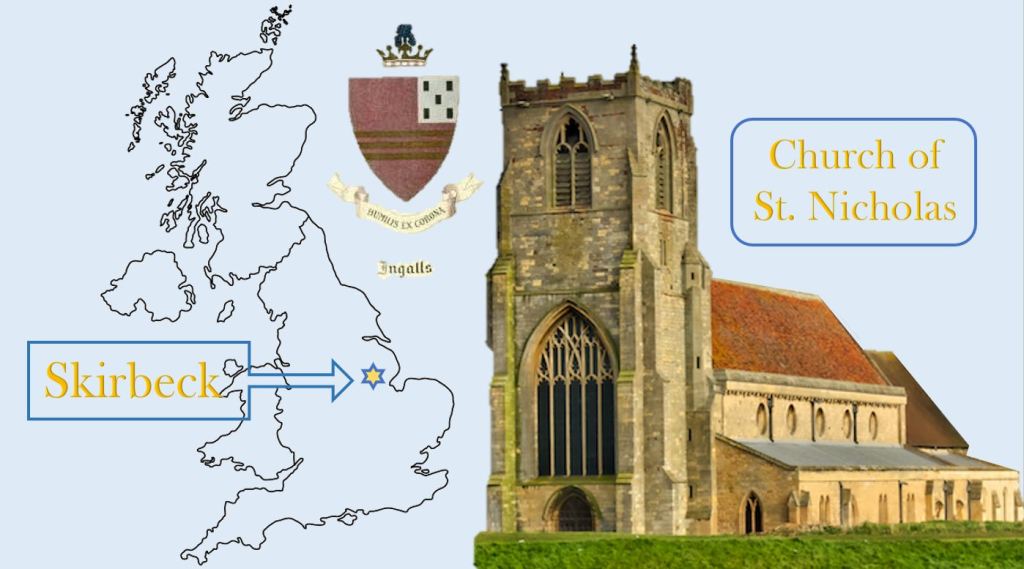
Back in the day, the church was the center of any English village. The Church of Saint Nicholas was no exception. Here is a summary of the church’s history, taken from Diocese of Lincoln, Skirbeck St. Nicholas:
The hamlet of Scirebec is listed in the Domesday Book of 1085 and predates the town of Boston by about 200 years. The name Skirbeck derives from Scirebec which means ‘clear stream’. This waterway, which has long since disappeared, formed the natural boundary on the northern and eastern side of the original Parish. The present Church of St Nicholas dates from approximately 1180 and has undergone many dilapidations and restorations over the centuries. The Church is adjacent to The Haven, tidal side of the River Witham, which forms the southern border. In the 16th century, after terrible high tides and flooding, much of the Church was beyond repair and, therefore, parts were demolished. Re-building of the north and south aisles took place in the late 19th century and the chancel completed in 1935.
Skirbeck Parish Profile PDF. Retrieved September 10, 2019, from https://d1x8239b43517c.cloudfront.net/media-uploads/3/6/job/10026/Skirbeck%20Parish%20Profile%20PDF.pdf
From the Genuki site, we know this information about the Church of St. Nicholas:
St. Nicholas Church was of Norman origin, parts of the church are from the 13th century, the church tower was a 15th century addition, and a small priory dedicated to Saint Mary once existed there.
Boston, Lincolnshire – GENUKI. Retrieved September 10, 2019, from https://www.genuki.org.uk/big/eng/LIN/Boston
The Ingalls family would have had strong connections to the Church of St. Nicholas. Every birth, marriage, death in the family would have been documented in church records. The family would have worshipped at this church from the days of Roman Catholicism, through the turbulent separation from the church of Rome and the establishment of the Church of England, and on to the impact of the Reformation in changing how the Word of God should be received and how worship should be conducted.
The Ingalls Family in the Skirbeck Parish
While we know the family likely farmed in the Skirbeck area in 1480 and earlier, the records kept by clerks at the Church of St. Nicholas were lost probably as a result of the flooding during the 16th century. The church’s earliest extant records date from 1661, 33 years after Edmund and Francis left with their families for the Massachusetts Bay Colony.
What we do know comes largely from Charles Burleigh’s The genealogy and history of the Ingalls family in America. According to Burleigh, the Ingalls name’s etymology is “By the Power of Thor” and that the “Doomsday book records a Baron Ingald, a tenet of King William at Rersbi and Elvestone, Leicestershire, A.D. 1080, who came from Normandy.” He suggests that Ingald is an early form of the Ingalls name.
Burleigh, C. (2018). The Genealogy and History of the Ingalls Family in America. Franklin Classics Trade Press.
Using notes from Burleigh’s book, a family tree dating from 1480, during the life of John Edmund Ingalls, to the Great Migration is as follows:
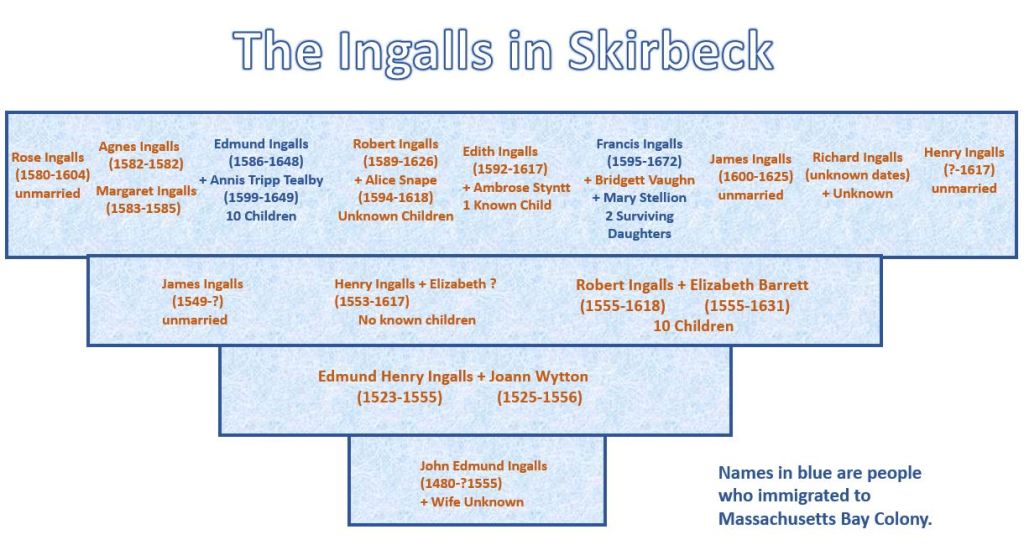
Edmund Henry Ingalls’s will indicates that he had 6 children, but Burleigh’s book names only three sons: James, Henry, and Robert. The summary of this will states that Edmund Henry mentions by name only son James and brother-in-law Thomas Wytton.
Ingalls family life in Skirbeck, Lincolnshire. While there is no available documentation of this, it can be assumed that a family that had farmed for many generations in Lincolnshire had also acquired significant acreage. For that reason, assuming the Ingalls were landed yeomen is reasonable.
According to Walter Renton Ingalls in his book The Ingalls Family in England and America, the Ingalls family “described themselves as yeomen and they owned some land, which probably they tilled, the eldest son inheriting and the younger sons entering into trades. Edmund Ingalls after he had been in Massachusetts for 20 years still retained a three-acre parcel of land in England, which he mentioned in his will. His ancestors for several generations at least had been well-to-do for the time. They kept a servant or two and they were of sufficient importance to make wills, and modest bequests to collateral relatives, and even a little to the poor.” The author goes on to tell us that, “to get settlers in order to develop trade,” the company sponsoring emigration promised 10 acres of land to families unable to pay passage and 50 acres to those who could. “Edmund and Francis Ingalls were evidently of the latter class, inasmuch as when the allotment of land were finally made they jointly received 120 acres.”
Ingalls, W. , Renton. (1930). The Ingalls Family in England and America.
Emigration of the Ingalls Family
In late June of 1628, Edmund Ingalls, Annis Tealby, their children, Francis Ingalls and his young daughter left England on the Abigail and arrived in Salem on September 6. In reading the top box on the above Ingalls in Skirbeck tree, note that Edmund and Francis’ father and all of their siblings had died prior to 1628. Very likely, Edmund sold a portion of his inherited farm land near Skirbeck to fund the journey.
Once in Massachusetts, Edmund and Francis explored the area, selected land, and founded the village of Lynn. The two families were welcomed by the Pawtucket people, a small tribe. As befitted a younger son, Francis had learned the trade of tanning. He put that skill to use, building the first tannery in America, and living near it. Edmund cleared land, built a home, and later a malt house. Edmund was a skilled brewer as well as a yeoman.
Young Henry, Edmund and Annis’s son and the progenitor of our family line, would have been just two years old when the family boarded the Abigail as part of Endicott’s New England Company for a Plantation in Massachusetts, a land grant sponsored by the Earl of Warwick on behalf of the Plymouth Council for New England. He would grow up in Lynn and then relocate to Andover as an adult.
In his summary of the Ingalls family, Burleigh stated, “The largest majority [of Ingalls ] have been tillers of the soil, industrious, caring little for public office, but always willing to assume such duties when called upon by their fellow citizens.”
Burleigh, C. (2018). The Genealogy and History of the Ingalls Family in America. Franklin Classics Trade Press.
Burleigh was correct; Ingalls families, especially our own line, have indeed been “tillers of the soil.” In fact, until our own grandfather, Almont Ingalls, died in 1944, every generation in our lineage has boasted the Ingalls’ devotion to husbandry of the land.
Life in Lynn
According to Burleigh’s account, Edmund’s name “is often found on town records showing him to be one of the prominent citizens.” Walter Renton Ingalls describes Edmund’s life in Lynn thus: “We may remind ourselves that from the earliest years in Massachusetts there were two parties among the colonists, one the sternly Puritan and the other the more broadminded. Out of the bitter controversy between them the Puritans emerged on top and for many decades they ran things in their own way. We may infer that the Ingalls’ were in the opposition. It is not of record that Edmund Ingalls ever became a freeman, which means that he did not acquire the right to vote. This implies nothing in respect of social status. In order to become a freeman a man had to be a member of the Congregational church in good standing. Edmund Ingalls either could not so qualify or he did not want to.” As for Edmund’s eldest son, “It is significant that Robert Ingalls and his sons did not become freemen until after 1690, in which year the religious qualification was entirely abolished and there was substituted the requirement of a certificate of good standing by the civil authorities. Immediately following this the principal adult male members of the family enrolled.” Consequently, we must assume Edmund and Francis Ingalls saw emigration as an adventure in commerce, not fundamentally a religious choice.
Burleigh, C. (2018). The Genealogy and History of the Ingalls Family in America. Franklin Classics Trade Press. Ingalls, W. , Renton. (1930). The Ingalls Family in England and America.
John Endecott | British colonial governor | Britannica.com. Retrieved September 10, 2019, from https://www.britannica.com/biography/John-Endecott
Edmund, his wife, his children, and his brother were doubtlessly religious people, but as W.R. Ingalls points out in The Ingalls Family in England and America, they were not people who blindly followed the direction of others or believed religion as intrinsic to governance. This independence may have grown from the turbulent decades of the Crown dictating religious practice. In any case, there are several instances of this family ignoring the dictates of church governance. Edmund was fined, for example, for gathering firewood on Sunday. His son Henry was fined for having Quakers to his home for dinner.


 24 and More
I think I am up to speed now. I love your blog!!!
LikeLike
I am so pleased to see this. I figured out how to get to comments. And I can even reply!
LikeLike