
Many people with sketchy knowledge of the Puritans who arrived in the Massachusetts Bay Colony during the Great Migration assume that most Puritan families were English commoners of limited means seeking religious freedom, land, and a better life. The truth is that, with the exception of servants, the Puritans were well educated, accomplished people of considerable means from the class of landed yeomen or members of the English nobility. One great example of this is the lineage of our ancestress Mary Osgood, wife of Henry Ingalls. It is from this couple that our ancestral line descends.
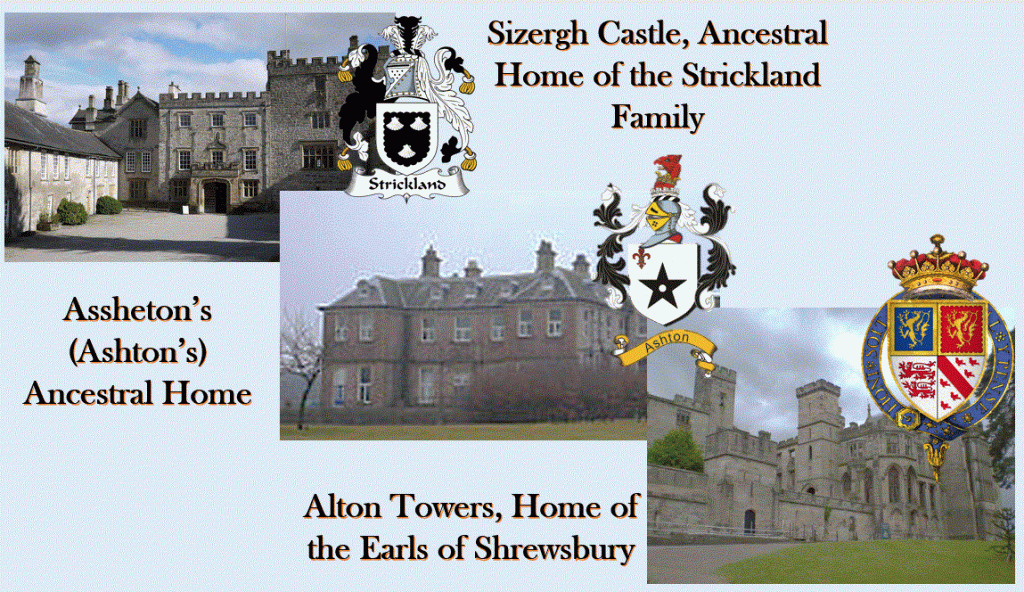
Mary’s mother was Sarah Ann Booth. Sarah and consequently Mary Osgood were directly descended from these three powerful noble families: the Stricklands, the Ashtons, and the Talbots (first two Earls of Shrewsbury). The histories of these families are extensive, possibly because the wealthy and powerful nobility kept thorough records of births, marriages, children, and deaths. Their records extend from Henry II (reign:1154-1189) to the present, but in Mary Osgood’s case, her English history ended with the reign of Charles I (reign:1625-1649).
Mary’s father was John Osgood. The Osgoods were landed gentry. They were yeomen, the class often called the Backbone of England. The family owned what was at the time a very large farm – very productive 360 acres and a large, sturdy home called Cottingworth. The lineage of John Osgood can be traced to the middle 1400s. Samuel Ingalls (1455-1510) married Ruth Eaton (1455-1510) near Nether Wallop, Hampshire. Their daughter, Mary Ingalls (1480-1550), married William Peter Osgood (1481-1534) in approximately 1503. While we cannot establish a familial connection between the Ingalls/Eaton family of Hampshire and the Ingalls of Lincolnshire, the Ingalls name suggests that Samuel Ingalls was at least a distant relative of the Lincolnshire Ingalls of our ancestry. If so, the connection between the Osgoods and Ingalls preceded Mary Osgood’s marriage to Henry Ingalls by about 150 years.
The Booth/Osgood Faith and Journey to the Massachusetts Bay Colony. After King Henry VIII’s separation of England from the Roman Catholic Church, the Osgoods produced in every generation at least one well-educated religious minister. This devotion to faith and the inspiration of the Reformation led to their demand for more than the Catholic-Lite approach of the Church of England. Their frustration with the 100 year long discord over religion since the 1534 establishment of the Church of England and the widespread intolerance of Puritans during that time led to the Osgood’s decision to immigrate to the Massachusetts Bay Colony in 1638.
Mary Osgood’s parents married in Wherwell, Hampshire, England on June 1, 1627. Mary was their first child, born July 6, 1628. When Sarah Ann sailed on the ship Confidence on April 11, 1638, she brought with her four of their children. Mary would have been nearly 10 years old at the time. They landed at Ipswich, but didn’t stay. Instead, they became one of the original settlers of Andover.
To see Mary Osgood’s lineage, go to https://www.ancestry.com/family-tree/tree/56002306/family?cfpid=42004027001.
Choose from Trees the Ingalls Family Tree. If this link doesn’t work, contact me via email to receive another link. When you view Mary’s lineage, you will be motivated to explore more about her ancestors. Find out which ancestor was
- praised in Shakespeare’s Henry plays
- married to a Parr — the family that produced Catherine Parr, Henry VIII’s 6th (and last) wife
- an alchemist
- a knight in the War of the Roses
- a Sheriff of Nottingham
- a lieutenant of the Tower of London
- captured by Joan of Arc
- a soldier in the Hundred Years War
- initiated into the Order of the Garter
- a Jacobite
- and so much more!
Here a few sources I found especially useful in researching Mary’s ancestors:
- Burke, J., & Burke, B. (1977). A Genealogical and Heraldic History of the Extinct and Dormant Baronetcies of England, Ireland, and Scotland. Genealogical Publishing Com.
- Burke, B., & Burke, J. (1851). The royal families of England, Scotland, and Wales, with their descendants, sovereigns and subjects. London, E. Churton.
- Chalmers, A. (1816). The General Biographical Dictionary Containing an Historical and Critical Account of the Lives and Writings of the Most Eminent Persons; . a New Ed. by Alex. Chalmers. In .
- John Talbot. (2019). Retrieved September 4, 2019, from Shropshirehistory.com website: http://shropshirehistory.com/characters/talbot.htm
- John Talbot, 1st earl of Shrewsbury | English military officer. (2019). In Encyclopædia Britannica. Retrieved from https://www.britannica.com/biography/John-Talbot-1st-earl-of-Shrewsbury*
- List of the Knights of the Garter (1348-present). (2014). Retrieved September 4, 2019, from Heraldica.org website: https://www.heraldica.org/topics/orders/garterlist.htm
- Stephen, S. L. (Ed.). (1922). Dictionary of National Biography (pp. 323 Talbot, John). Retrieved from https://www.ancestry.com/search/collections/dictnatbiogv1/ (Original work published 1922)*
- Thornber, C. (n.d.). Assheton of Downham. Retrieved from https://www.thornber.net/famhist/htmlfiles/ashton.html
- Washington, G. (2004). The early history of the Stricklands of Sizergh. Salem, Mass.: Higginson Book Co.
 24 and More